Nathaniel Picard-Busky
  • Home
  • Media
    • Photos >
      • My Guitars
      • Shows
    • Videos
    • Music
  • Improv Lessons
  • Technical Projects
  • Contact

Electronics Technology Lab Report Number 5

3/13/2014

0 Comments

 
Experiments:

Reverse Diode:
     This circuit bevels off the top of the sine wave. When you change the volume, it simply deepens the curve on the bottom. When frequency is brought up, the back side of the wave cuts off more steeply.
Forward Diode:
    This circuit bevels off the bottom of the sine wave. Just as in the reverse diode circuit, when you change the volume, it simply deepens the curve on the bottom and when frequency is brought up, the back side of the wave cuts off more steeply.
Forward Diode to Ground:
   This circuit cuts off the top of the wave sharply and widens it significantly. As you raise the volume, the effect becomes more and more present. As you change frequency, there is little to no change in the shape of the waveform.
Reverse Diode to Ground:
  This circuit is the opposite of the forward diode to ground, cutting of the bottom of the wave and widening it. Similarly, as you raise the volume, the effect becomes more and more present and as you change frequency, there is little to no change in the shape of the waveform.


Questions:

A peak follower creates a decay by charging up and slowly draining a capacitor. It can be used to control any number of voltage controlled modules (VCOs, VCFs, etc). By simply adjusting the volume of the inputted signal, the shape of the curve can be made steeper or smoother depending on whether the volume was moved up or down. Using a peak follower, you could control the frequency of a VCO to make a tremolo effect or manipulate the cutoff frequency of a VCF to make an envelope.

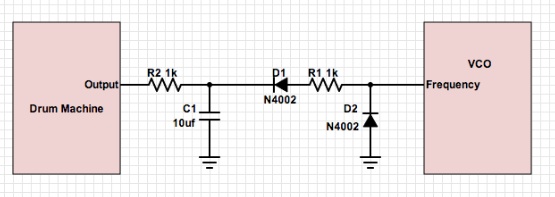
Below is a diagram of a circuit that would take the low frequencies of a drum machine, applies a smooth, almost square filter to the signal and then uses that signal to control the frequency of a voltage controlled oscillator.
The initial resistor and then capacitor to ground form the filter to send through frequencies around 10-20Hz (see my previous post for more information about these types of filters), and then the following combination of reverse diode and reverse-biased diode to ground creates the filter.
Picture
Final Project:

     My final project is looking very plausible. I have been researching the potential for photoresistors in applications like mine. While the optimal device would be a proximity sensor, these parts cost upwards of $30 per unit so they are entirely out of contention. I have found that photoresistors are in a lot of things, from camera light sensors, to outdoor lights and night lights, these small, inexpensive devices are in many consumer electronics. I have many of these device at home not in use so I can take these apart and retrieve the LDRs (light-dependent resistors) from them. Unfortunately, I have hit one obstacle. Since the LDRs are essentially just variable resistors, I will have to do all the calculations to make sure that they are in the correct range for my application. For example, if I wanted to use my device as an extension of an existing effect pedal, I would have to be sure that my LDRs match the existing resistors in the device so that the circuit within the effect would not be put off balance. Because of this, there is a chance that I will not be able to find an LDR that works for my application and I will have to add on extra circuitry to make up for this. Also, because of this, it will be very hard to make the device compatible with a wide range of preexisting effects. Each effect has a different circuit and different value potentiometers. Because of these complications I am leaning towards an on board, or at least personally made set of filters that I will design to work well with the LDRs that are available.
0 Comments


Leave a Reply.

    Archives

    May 2017
    May 2015
    April 2015
    March 2015
    February 2015
    May 2014
    April 2014
    March 2014
    February 2014

    Categories

    All
    --> Built In Looper
    --> Onboard Light-Controlled Analog Guitar Effects
    --> Small-Format Multi-Effects Pedal

    RSS Feed

  • Home
  • Media
    • Photos >
      • My Guitars
      • Shows
    • Videos
    • Music
  • Improv Lessons
  • Technical Projects
  • Contact